
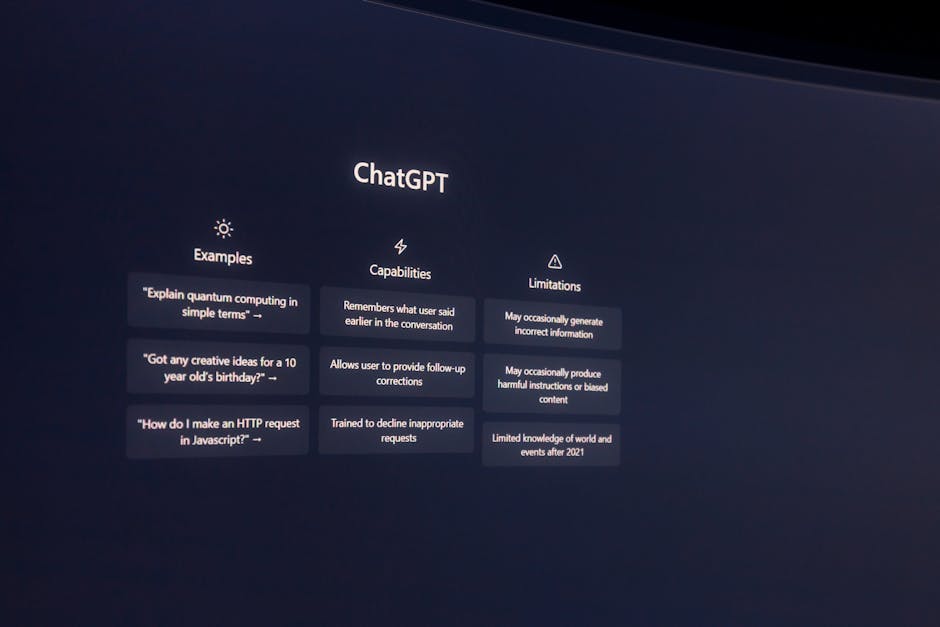

The dazzling rise of generative AI
Generative AI has captivated the world, churning out everything from stunning artwork and compelling stories to functional code and realistic voices. Tools like ChatGPT, Midjourney, and Stable Diffusion have democratized creativity and supercharged productivity, making it easy to forget that these powerful systems aren’t infallible. While their capabilities are undeniably impressive, understanding their limitations is crucial for anyone looking to leverage AI effectively and responsibly. At TechDecoded, we believe in demystifying technology, and that includes shedding light on the less glamorous, but equally important, aspects of AI.

The persistent problem of AI hallucinations
One of the most widely discussed limitations of generative AI is its tendency to “hallucinate.” This isn’t about seeing things that aren’t there in a human sense, but rather about generating information that sounds perfectly plausible yet is entirely false or nonsensical. Whether it’s fabricating non-existent research papers, inventing historical events, or providing incorrect medical advice, AI models can confidently present misinformation as fact.
- Factual inaccuracies: Generating incorrect dates, names, or statistics.
- Made-up citations: Inventing sources or attributing quotes to the wrong people.
- Logical inconsistencies: Producing text that contradicts itself within the same output.
This challenge stems from how these models learn: they predict the next most probable word or pixel based on patterns in their training data, not from a deep understanding of truth or reality. Always cross-reference critical information generated by AI with reliable sources.

Lack of true understanding and common sense
Despite their sophisticated outputs, generative AI models don’t possess genuine understanding, consciousness, or common sense. They are pattern-matching machines, excellent at identifying statistical relationships in vast datasets. They don’t “know” what a cat is in the way a human does; they just know how the word “cat” relates to other words and images in their training data.
- Contextual blind spots: Struggling with nuanced situations that require real-world knowledge beyond their training.
- Inability to reason: Failing at tasks requiring complex logical deduction or abstract thought not explicitly present in their data.
- Fragility to novel situations: Performing poorly when faced with scenarios significantly different from their training examples.
This means their “intelligence” is narrow and brittle. They can mimic human-like responses but lack the underlying cognitive framework that allows humans to adapt, learn from single examples, or apply common sense to novel problems.

Bias embedded in training data
Generative AI models are only as good, and as unbiased, as the data they are trained on. If the training data reflects societal biases – whether related to race, gender, socioeconomic status, or any other demographic – the AI will learn and perpetuate those biases in its outputs. This can lead to unfair, discriminatory, or stereotypical content generation.
- Stereotypical representations: Generating images or text that reinforce harmful stereotypes.
- Exclusion and misrepresentation: Overlooking or misrepresenting certain groups.
- Unfair outcomes: Potentially leading to biased decisions in applications like hiring or loan approvals if integrated without careful oversight.
Addressing bias requires meticulous data curation, ongoing monitoring, and active efforts to diversify datasets, but it remains a significant and complex challenge.

Constraints on genuine creativity and originality
While generative AI can produce astonishingly creative-looking outputs, its “creativity” is fundamentally different from human creativity. AI models remix, combine, and extrapolate from existing patterns they’ve observed. They don’t experience inspiration, conceptualize entirely new paradigms, or break free from their training data in a truly original way.
- Derivative outputs: Often producing content that feels familiar or a variation of existing styles.
- Lack of true innovation: Struggling to generate concepts that are genuinely novel and push beyond current human understanding.
- Repetitive patterns: Sometimes falling into predictable stylistic ruts or repeating themes.
For truly groundbreaking ideas or art that challenges conventions, human ingenuity remains irreplaceable. AI serves better as a powerful co-pilot or tool for iteration rather than a sole originator.

The “black box” problem and explainability
Many advanced generative AI models, particularly large language models and deep learning networks, operate as “black boxes.” It’s incredibly difficult, sometimes impossible, to understand precisely why a model produced a specific output. The complex interplay of billions of parameters makes tracing the decision-making process opaque.
- Lack of transparency: Inability to audit or debug the internal reasoning of the AI.
- Trust issues: Difficulty in trusting AI outputs when the rationale behind them is unknown.
- Regulatory challenges: Posing problems for industries requiring explainable decisions, like finance or healthcare.
This lack of explainability hinders our ability to identify and correct errors, mitigate biases, and build full confidence in AI systems, especially in high-stakes applications.

A practical path forward with generative AI
Understanding these limitations isn’t about dismissing generative AI; it’s about fostering a more informed and responsible approach to its use. Generative AI is a revolutionary technology, but it’s a tool, not a sentient being. Its power is amplified when paired with human oversight, critical thinking, and ethical considerations.
- Human in the loop: Always review and verify AI-generated content, especially for critical tasks.
- Critical evaluation: Approach AI outputs with a healthy dose of skepticism, questioning sources and logical consistency.
- Ethical development: Support and advocate for AI development that prioritizes fairness, transparency, and accountability.
- Continuous learning: Stay updated on AI advancements and evolving best practices for its application.
By acknowledging and actively working around these boundaries, we can harness the incredible potential of generative AI while minimizing its risks, ensuring it serves humanity in a truly beneficial way.




Leave a Comment