


Understanding deep learning: AI’s powerful engine
Artificial intelligence (AI) is transforming our world, from how we interact with technology to how industries operate. At the heart of many of these groundbreaking advancements lies a fascinating subset of machine learning called deep learning. But what exactly is deep learning, and how does it enable machines to learn and perform complex tasks with such impressive accuracy?
At TechDecoded, we’re all about making complex tech concepts clear and practical. In this article, we’ll break down deep learning, explain its core components, and show you how it’s shaping the future.

Deep learning, machine learning, and AI: What’s the difference?
Before diving deep, let’s clarify the relationship between these often-interchanged terms:
- Artificial intelligence (AI) is the broadest concept, referring to machines that can perform tasks that typically require human intelligence. This includes problem-solving, learning, decision-making, and understanding language.
- Machine learning (ML) is a subset of AI that focuses on enabling systems to learn from data without explicit programming. Instead of being given step-by-step instructions, ML algorithms identify patterns in data and make predictions or decisions based on those patterns.
- Deep learning (DL) is a specialized subset of machine learning. It uses artificial neural networks with multiple layers (hence ‘deep’) to learn from vast amounts of data. Deep learning excels at tasks like image recognition, natural language processing, and speech recognition, often achieving state-of-the-art performance.
Think of it like this: AI is the big family, machine learning is a branch of that family, and deep learning is a specific, highly capable member of the machine learning branch.

How deep learning works: The power of neural networks
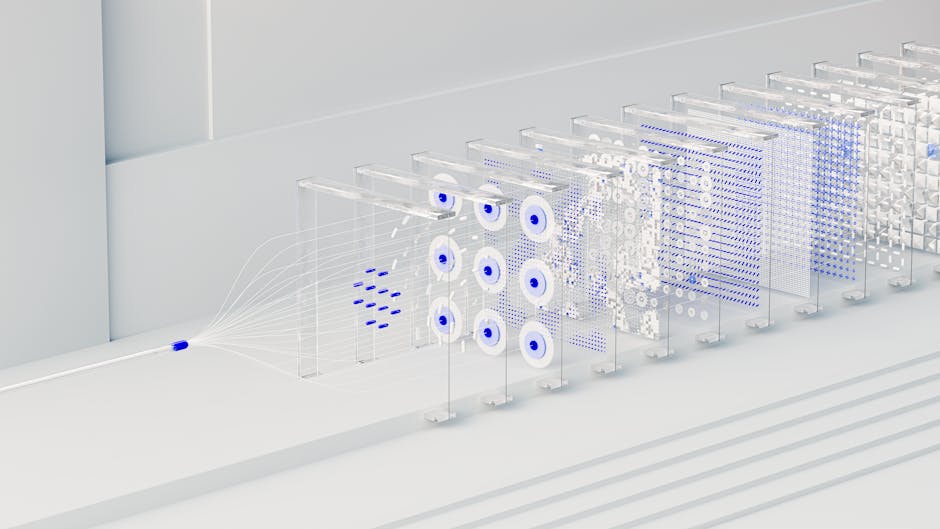
The core of deep learning lies in artificial neural networks (ANNs), which are inspired by the structure and function of the human brain. These networks consist of interconnected ‘neurons’ organized into layers:
- Input layer: This is where your data (e.g., pixels from an image, words from a sentence) enters the network.
- Hidden layers: These are the ‘deep’ part of deep learning. There can be many hidden layers, each performing complex computations on the data received from the previous layer. Each layer learns to recognize different features or patterns in the data, gradually building up a more abstract understanding.
- Output layer: This layer produces the final result, such as classifying an image as a ‘cat’ or ‘dog’, or translating a sentence.
During the training process, the network is fed massive amounts of data. It adjusts the connections (weights) between its neurons based on how accurately it predicts the outcome. This iterative process, often involving techniques like backpropagation, allows the network to ‘learn’ and improve its performance over time.

Key components that fuel deep learning
For deep learning models to thrive, several crucial elements are required:
- Massive datasets: Deep learning models are data-hungry. They need vast quantities of labeled data to learn effectively and generalize patterns. The more data, the better they perform.
- Powerful algorithms: Sophisticated algorithms, such as convolutional neural networks (CNNs) for images or recurrent neural networks (RNNs) and transformers for sequential data like text, are designed to process specific types of information efficiently.
- High-performance computing: Training deep learning models, especially large ones, requires immense computational power. Graphics Processing Units (GPUs) and Tensor Processing Units (TPUs) are commonly used because of their ability to perform parallel computations much faster than traditional CPUs.
Real-world applications of deep learning
Deep learning is no longer just a research topic; it’s integrated into countless technologies we use daily:
- Image and video recognition: From facial recognition on your smartphone to medical image analysis for disease detection, deep learning powers systems that can ‘see’ and interpret visual information.
- Natural language processing (NLP): Virtual assistants like Siri and Alexa, language translation tools, and spam filters all leverage deep learning to understand, generate, and translate human language.
- Self-driving cars: Deep learning algorithms process sensor data (cameras, radar, lidar) to perceive the environment, detect objects, and make real-time driving decisions.
- Recommendation systems: Platforms like Netflix and Amazon use deep learning to analyze your past behavior and recommend movies, products, or music you might like.
- Drug discovery and healthcare: Deep learning is accelerating the identification of new drug candidates, analyzing patient data for personalized treatments, and assisting in diagnostics.

Embracing the deep learning revolution
Deep learning has undeniably pushed the boundaries of what AI can achieve, bringing us closer to truly intelligent machines. While it presents challenges like the need for vast data and computational resources, its potential to solve complex problems across various domains is immense.
As deep learning continues to evolve, understanding its fundamentals becomes increasingly important for anyone looking to navigate or contribute to the future of technology. At TechDecoded, we’ll keep breaking down these powerful tools, helping you understand and harness their potential in a practical, human-friendly way.



Leave a Comment